Standfirst: US Part 107 night operations require
more than switching on a visible LED. The light has a collision-warning
job, the pilot needs current night-operations knowledge, controlled
airspace still needs authorisation, and visual line of sight does not
disappear after sunset.
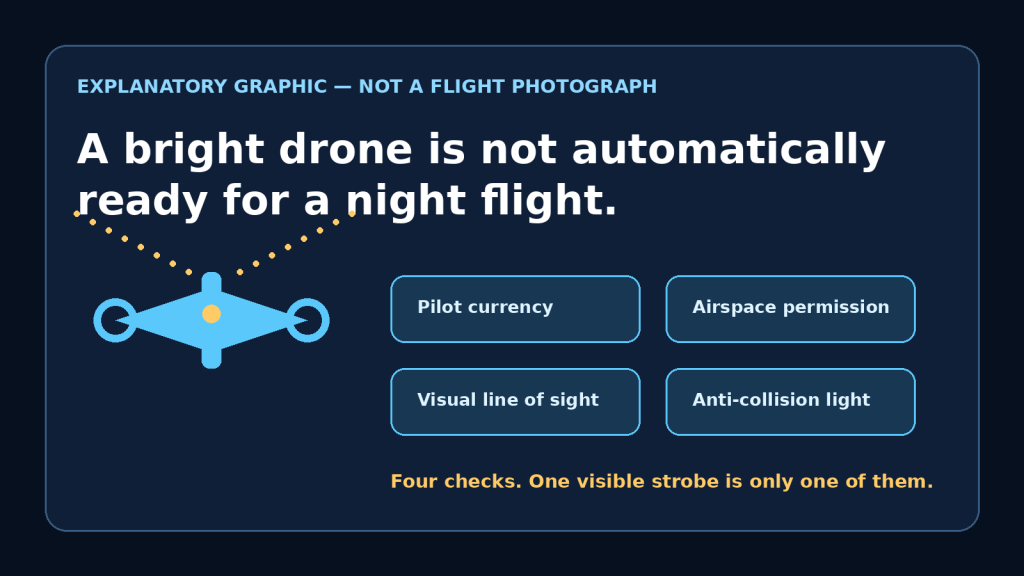
A drone lifts off after sunset with a bright flashing light. From the
launch point, the aircraft is easy to spot. That can feel like the
decisive night-flight check.
It is not.
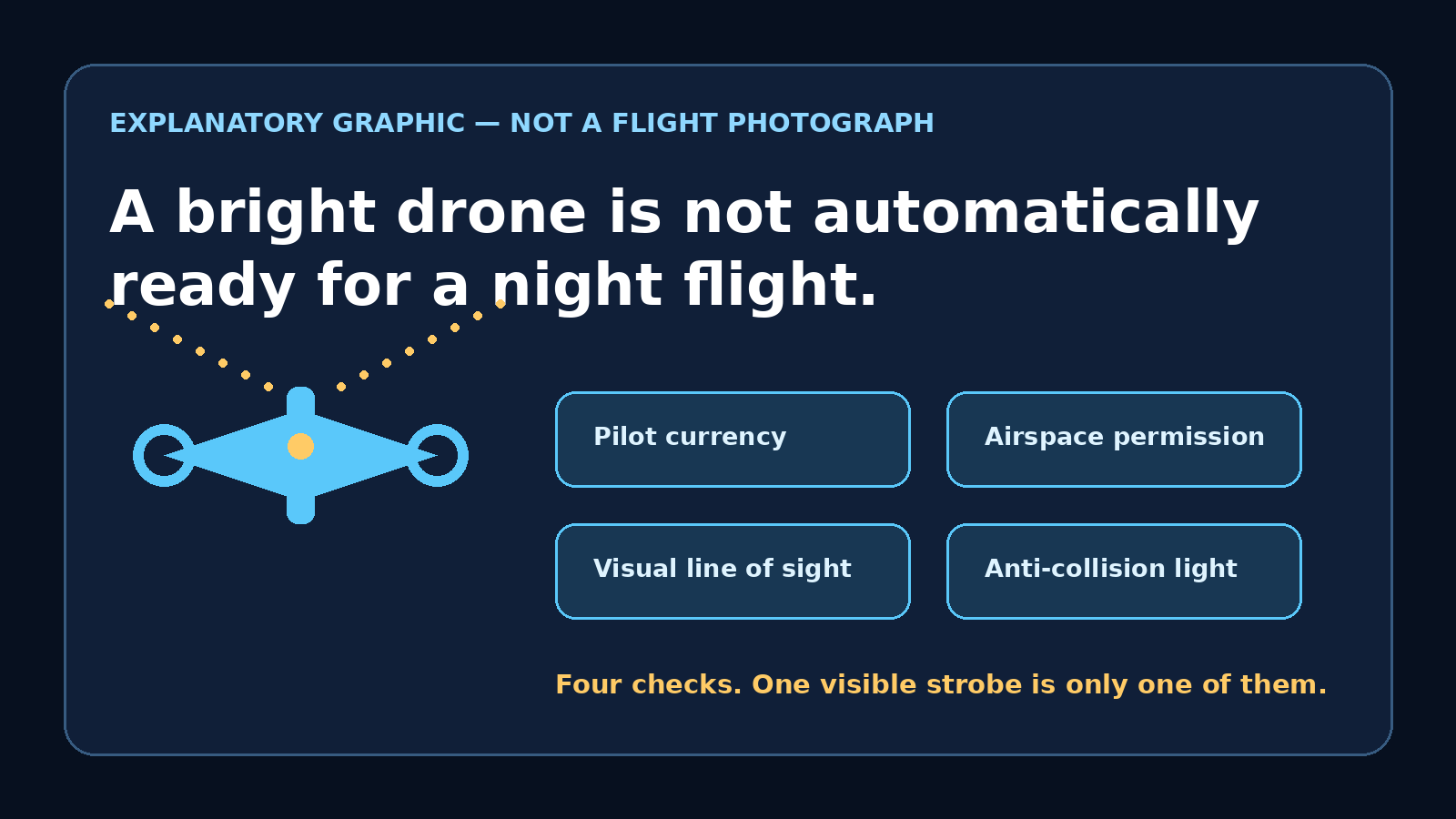
The Federal Aviation Administration’s night rule is built around
several separate questions: Is the remote pilot qualified and current?
Is the aircraft carrying anti-collision lighting that meets the rule?
Can the crew still maintain visual line of sight and scan for other
traffic? Is the airspace available for the flight? A “yes” to the
lighting question does not answer the others.
The most common misunderstanding starts with the number in the rule.
A light that must be visible for at least three statute miles does not
give a drone pilot permission to fly three miles away. It describes the
performance of the anti-collision light, not the permitted distance
between the pilot and the aircraft.
The
light is meant to make the drone conspicuous to other airspace
users
Section 107.29 requires a small unmanned aircraft operating at night
to have lighted anti-collision lighting visible for at least three
statute miles, with a flash rate sufficient to avoid a collision. The
same lighting requirement applies during civil twilight.
The FAA’s final rule explains the purpose: the light is intended to
make the small aircraft more noticeable to other pilots sharing the
airspace. It is not primarily an orientation light for the remote pilot.
A red or green arm light that helps the operator tell the front of the
drone from the rear may be useful, but usefulness is not the same as
satisfying the anti-collision requirement.
This is also why brightness at the controller does not settle the
question. A light can look intense at 30 metres while being partly
blocked by the battery, payload, landing gear or aircraft body from
another direction. The rule is performance-based. The remote pilot is
responsible for ensuring the system is operating and meets the
visibility and flash-rate requirements at the operating location.
The FAA has said there is no separate prescriptive US drone standard
for colour, position or orientation beyond the visibility requirement.
That flexibility does not mean every clip-on strobe automatically
complies. The relevant evidence is the product’s documented performance,
its installation and whether it remains visible as intended on the
actual aircraft.
Three
miles of light is not three miles of visual line of sight
Part 107’s visual-line-of-sight requirement remains in force at
night. The remote pilot, the person manipulating the controls and any
visual observer used for the operation must be able to see the unmanned
aircraft with unaided vision other than corrective lenses. That
capability must let the crew know its location, attitude, altitude and
direction of flight, observe the airspace for traffic or hazards, and
determine that the flight does not endanger people or property.
A flashing point may be visible while the aircraft’s attitude or
movement is no longer reliably clear. The anti-collision light’s
advertised range therefore cannot be copied into a mission plan as a
flight radius.
The rule also does not transform binoculars, a live camera feed or a
map icon into visual line of sight. Those tools may assist particular
tasks, but the Part 107 crew still needs the required unaided visual
capability unless operating under an applicable waiver.
Night makes this distinction harder, not easier. Distance judgement
changes against a dark background; nearby lights can be confused with
the aircraft; and a very bright strobe can damage the operator’s dark
adaptation when viewed at close range. FAA guidance specifically allows
the remote pilot to reduce the light’s intensity when operating
conditions make that safer. It may not be extinguished when the rule
requires it.
Training and currency
are a separate gate
Routine Part 107 night operations became available without a night
waiver in 2021, but only under the rule’s conditions. Section 107.29
requires the remote pilot in command to have completed the applicable
initial knowledge test or training after 6 April 2021. The updated
material includes night operations.
Part 107 pilots must also keep their aeronautical knowledge current.
FAA guidance says a certificate holder needs the appropriate recurrent
online training within the previous 24 calendar months to exercise Part
107 privileges. A plastic certificate with no printed expiry date is not
evidence that the knowledge-currency requirement has been met
indefinitely.
This produces a practical document check before a night job: confirm
the pilot’s initial or recurrent course history, not merely the
certificate number. Lighting cannot cure an expired currency window.
Airspace
permission does not arrive with sunset—or with the light
The night rule and the airspace rule solve different problems.
Section 107.29 addresses the conditions for operating at night. Section
107.41 requires prior air traffic control authorisation for operations
in Class B, C or D airspace and within the lateral boundaries of the
surface area of Class E airspace designated for an airport.
The FAA states that Part 107 pilots can use LAANC where it is
available or apply through DroneZone where the manual route is required.
An authorisation may contain a time window, altitude limit and other
conditions. The fact that an app accepts a night request does not erase
the lighting, training, weather or visual-line-of-sight rules.
Conversely, an anti-collision light does not make an airport grid
available. It is equipment, not an airspace clearance.
Temporary flight restrictions, security restrictions, local
launch-site rules and landowner permission can also matter. A pre-flight
check has to use current information for the place and time of
operation; a successful flight from the same site last month is not a
standing authorisation.
The second “three
miles” is about weather
Part 107 also sets a minimum flight visibility of three statute miles
as observed from the control station. This is separate from the
requirement that the anti-collision light be visible for at least three
statute miles.
The two numbers can be easy to collapse into one checklist item, but
they describe different evidence:
- Light performance: Can the anti-collision system
meet the conspicuity requirement? - Flight visibility: Do the current atmospheric
conditions meet the operating minimum from the control station?
A compliant light does not make fog transparent. A clear night does
not certify a weak or obstructed strobe.
A defensible night-flight
check
The following sequence keeps the separate obligations separate.
- Confirm the operation and airspace. Check current
airspace, restrictions, the launch site and any required LAANC or
DroneZone authorisation. Record the applicable time and altitude
conditions. - Confirm pilot currency. Verify the relevant initial
or recurrent Part 107 training date and ensure it covers the current
operation. - Identify the anti-collision system. Record the
light model or built-in system and retain the manufacturer’s visibility
and flash documentation. Do not infer a three-mile rating from a
marketplace description that provides no test basis. - Inspect the installation. Make sure the light is
secure, charged and not obscured by the aircraft, payload or
accessories. Check that the attachment does not interfere with
propellers, vents, antennas or sensors. - Check the actual display before launch. Confirm the
intended flash mode and look for glare or reflections that could
distract the crew. A close-range ground check can reveal obstruction and
configuration errors; it should not be misrepresented as proof of
three-mile performance. - Brief the crew. Agree on who maintains visual
contact, who scans for other aircraft, how loss of orientation will be
called and what will trigger an immediate landing. - Set conservative limits. Terrain, background
lighting, haze and the aircraft’s apparent size may shorten the useful
operating distance well before the anti-collision light disappears. - Land when a required layer fails. A light failure,
loss of visual capability, deteriorating visibility or an airspace
conflict is not solved by relying harder on the video feed.
No light was tested for this article, and this is not a product
recommendation. Equipment claims must be checked against the exact
model, mounting method and operating conditions.
What the flashing light
actually proves
A visible strobe proves one narrow thing: the crew can currently see
a flashing light associated with the aircraft. It does not, by itself,
prove the light meets the three-statute-mile performance requirement,
that the pilot is current, that the operation has airspace approval or
that visual line of sight is being maintained.
That is the useful mental model for night work. Anti-collision
lighting is one safety layer with a specific purpose. Pilot knowledge,
visual capability, weather, airspace permission, site control and an
early decision to land remain separate layers. A bright drone can still
be an unready flight.
Primary sources
- Electronic Code of Federal Regulations, 14 CFR §107.29, Operation at
night: https://www.ecfr.gov/current/title-14/chapter-I/subchapter-F/part-107/subpart-B/section-107.29 - Electronic Code of Federal Regulations, 14 CFR §107.31, Visual line
of sight aircraft operation: https://www.ecfr.gov/current/title-14/chapter-I/subchapter-F/part-107/subpart-B/section-107.31 - Electronic Code of Federal Regulations, 14 CFR §107.41, Operation in
certain airspace: https://www.ecfr.gov/current/title-14/chapter-I/subchapter-F/part-107/subpart-B/section-107.41 - Electronic Code of Federal Regulations, 14 CFR §107.51, Operating
limitations: https://www.ecfr.gov/current/title-14/chapter-I/subchapter-F/part-107/subpart-B/section-107.51 - Federal Aviation Administration, Operations Over People General
Overview, night-operations conditions: https://www.faa.gov/uas/commercial_operators/operations_over_people - Federal Aviation Administration, Operation of Small Unmanned
Aircraft Systems Over People final rule, lighting purpose and
performance discussion: https://www.faa.gov/sites/faa.gov/files/2021-08/OOP_Final%20Rule.pdf - Federal Aviation Administration, Become a Certificated Remote Pilot,
recurrent training and currency: https://www.faa.gov/uas/commercial_operators/become_a_drone_pilot - Federal Aviation Administration, Part 107 Airspace Authorizations:
https://www.faa.gov/uas/commercial_operators/part_107_airspace_authorizations
Jurisdiction note: This article describes United States federal
Part 107 rules and FAA guidance checked on 24 October 2026. Waivers,
authorisation conditions, site rules and other jurisdictions may differ.
It is general safety information, not legal advice.


Leave a Reply