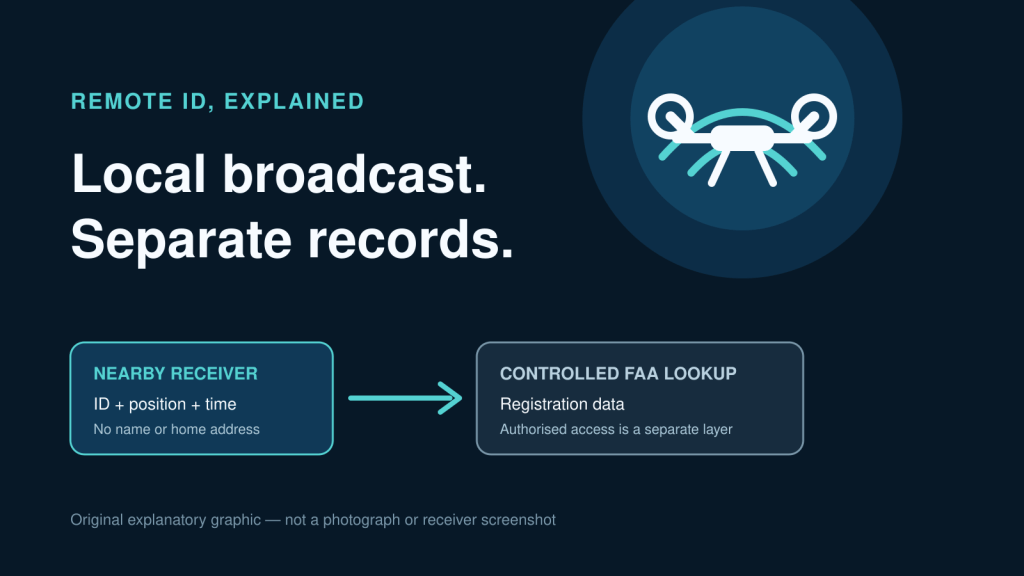
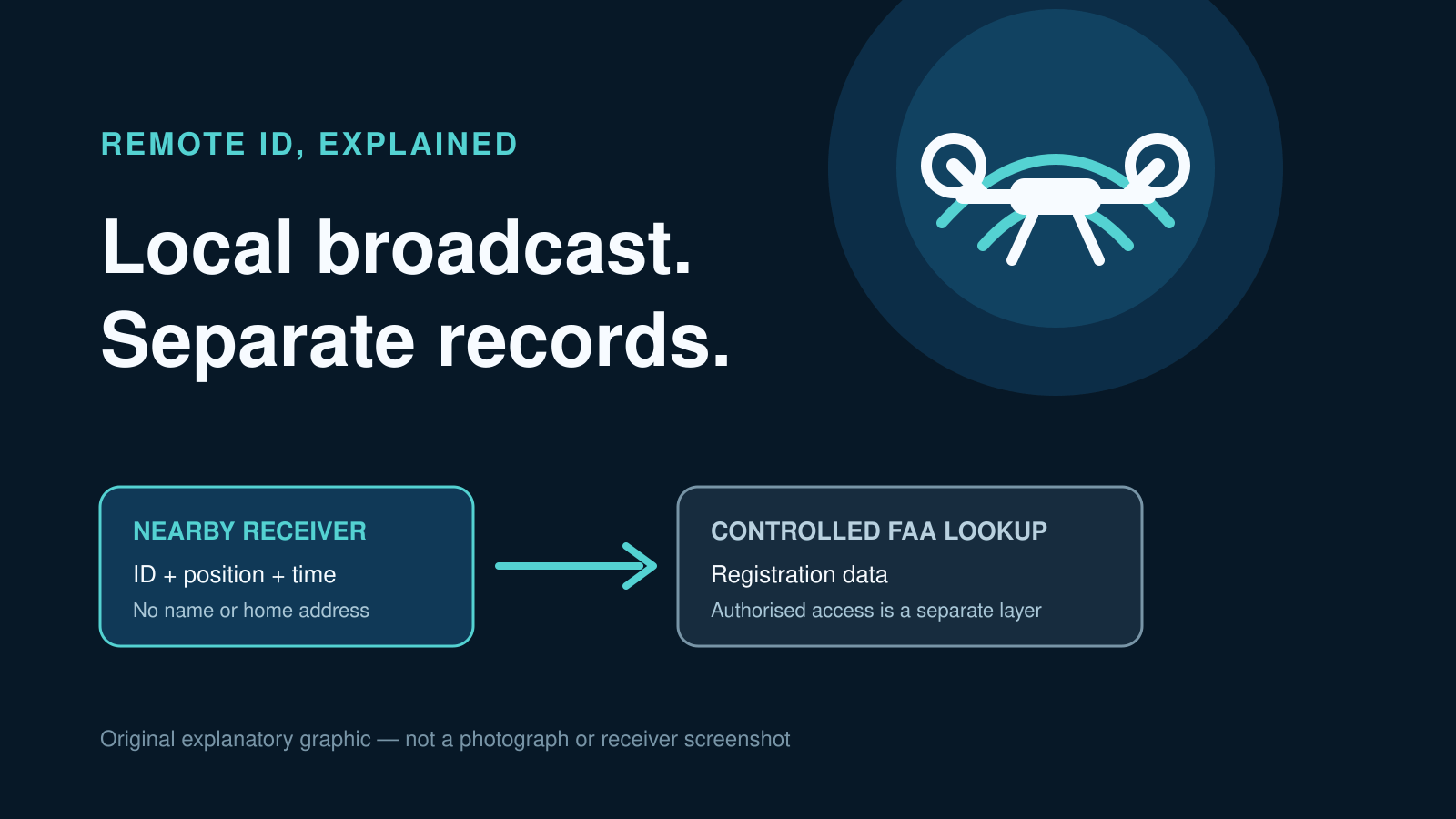
Standfirst: A nearby receiver can obtain a Remote ID signal without using the internet, but the broadcast does not contain a pilot’s name, home address or telephone number. The distinction between what is transmitted and what the FAA keeps in its registration system matters for both privacy and accountability.
If you fly a drone in the United States, “Remote ID” is best understood as two related but separate layers: a short-range radio broadcast from the aircraft and registration records held by the Federal Aviation Administration.
Mixing those layers together creates a persistent myth: that anybody with a phone can open a national map and read a pilot’s personal details. That is not what the required broadcast message contains.
What a nearby receiver can obtain
Most drones that are required to comply use either built-in Standard Remote ID or a separate broadcast module. In both cases, the aircraft sends a radio signal over Wi-Fi or Bluetooth while it is operating. A compatible receiver in range can listen directly; the basic broadcast does not depend on an internet connection or an FAA account.
For Standard Remote ID, the required message elements include an aircraft identifier; the aircraft’s latitude, longitude, geometric altitude and velocity; the control station’s latitude, longitude and geometric altitude; a time mark; and an emergency-status indication. A broadcast module instead sends the module’s serial number, the drone’s position and movement, the take-off location and a time mark.
That difference is important. With a Standard Remote ID aircraft, the control-station position is part of the message. With a module, the rule uses the take-off location rather than a continuously updated control-station location. A public display may not make those two cases obvious to a bystander, so an app’s pin should not automatically be described as “the pilot’s exact position.”
The broadcast is local rather than a public, FAA-hosted, nationwide flight history. Reception depends on compatible equipment, signal conditions and proximity. The FAA rule requires the drone to broadcast; it does not promise that every phone will receive every message or define a universal consumer-app experience.
What is not in the broadcast
The required message set does not include the pilot’s name, postal address, email address or telephone number. Those details can exist in the FAA’s registration system, but they are not message elements sent over the local Remote ID radio link.
That does not make the identifier meaningless. A Standard Remote ID aircraft broadcasts either a serial number or a session ID, depending on the approved design and operating choice. A module broadcasts its serial number. An observer can therefore distinguish one broadcast source from another and follow its changing position while reception continues. But turning that identifier into a person or organisation requires another data source and appropriate access.
This is the key privacy boundary: receiving the radio message and resolving the identifier against government records are separate acts.
What operators should assume in practice
Operators should plan on the basis that their aircraft’s location and either the control-station or take-off location can be visible to people nearby. Privacy cannot be created by assuming that nobody has a receiver.
For a lawful operation, that leads to practical choices rather than tricks to defeat the signal:
- Choose the launch point deliberately. Avoid using a private residential location when a lawful, safer public launch site would serve the operation just as well. Permission, airspace, local restrictions and site safety still apply.
- Expect questions. A concise explanation of the flight’s purpose and safety boundaries can de-escalate concern, but it does not replace permission or regulatory compliance.
- Protect unrelated information. Remote ID is only one data stream. Vehicle branding, social posts, live-video links and visible paperwork may reveal more personal information than the broadcast itself.
- Do not disable required equipment. For operations subject to Part 89, the equipment must be designed so that the operator cannot disable Remote ID. If the broadcast fails after take-off, the rule generally requires the pilot to land as soon as practicable.
- Treat app labels cautiously. A dot marked “pilot” may represent a control station on a Standard Remote ID aircraft or the take-off location for a module. The rule’s message type matters more than an app’s shorthand.
What nearby observers should not infer
A Remote ID display can support a safety conversation, but it is not a complete account of legality or intent. A visible identifier does not tell an observer whether the pilot has a waiver, authorisation or other documentation. Likewise, failure to see a broadcast on one device does not prove that a flight is unlawful: the aircraft may fall within an exception, be operating in an FAA-recognised identification area, or simply be outside the receiver’s effective range.
Immediate hazards should be reported through the appropriate emergency or aviation channel, not handled by approaching an aircraft or interfering with its operation. For non-urgent concerns, recording the time, location and exact observed behaviour is more useful than guessing the operator’s identity from an app.
The useful mental model
Remote ID is best pictured as a licence plate transmitted over local radio, with important limits to that analogy. Nearby people can read the machine identifier and movement data. The FAA separately maintains registration information, but the broadcast alone does not expose the registrant fields stored in that separate system.
For operators, the privacy lesson is not that personal details are being broadcast—they are not part of the required message set—but that a launch location and flight path can still reveal a great deal. For the public, the accountability lesson is that the signal supplies evidence about an aircraft, not a licence to identify, confront or accuse a person.
Primary sources
- Federal Aviation Administration, “Remote Identification of Drones,” current compliance overview and message descriptions: https://www.faa.gov/uas/getting_started/remote_id
- 14 CFR Part 89, Remote Identification of Unmanned Aircraft: https://www.ecfr.gov/current/title-14/chapter-I/subchapter-F/part-89
- Federal Register, “Remote Identification of Unmanned Aircraft,” final rule published 15 January 2021: https://www.federalregister.gov/documents/2021/01/15/2020-28948/remote-identification-of-unmanned-aircraft
- Federal Aviation Administration, “Register Your Drone,” registration information: https://www.faa.gov/uas/getting_started/register_drone
Jurisdiction note: This article describes United States federal Remote ID rules. State and local laws, site rules and other federal requirements may also apply. It is general information, not legal advice.


Leave a Reply