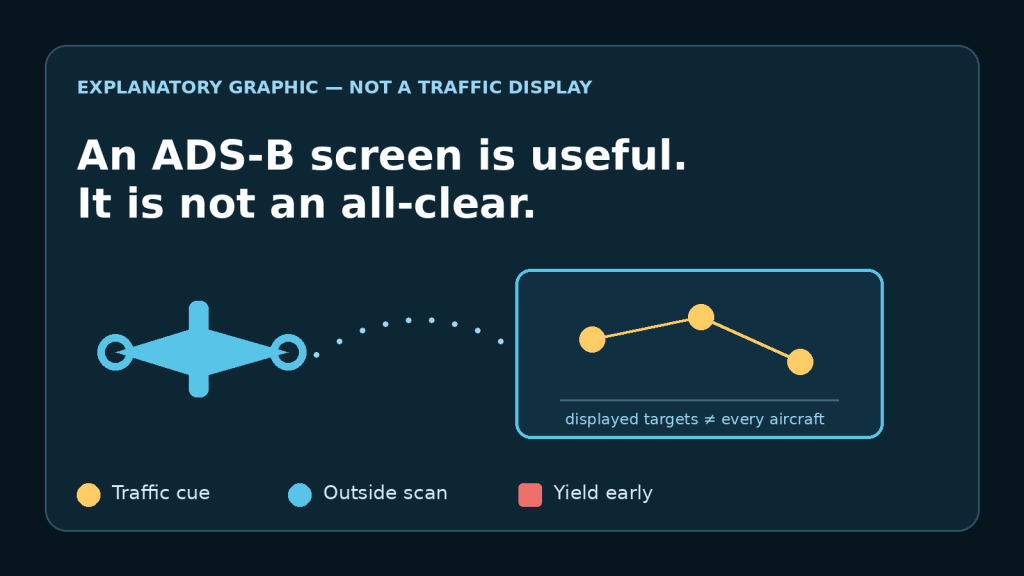
Standfirst: ADS-B can reveal useful nearby-aircraft information, but the FAA says traffic displays are incomplete and intended for situational awareness. For a US Part 107 drone pilot, the screen supplements an outside scan; it does not replace visual line of sight, right-of-way duties or airspace authorisation.
A traffic target appears on a tablet, moves across the map and then disappears. The tempting conclusion is that the aircraft has left. A more careful conclusion is smaller: the receiver is no longer presenting that target.
Those statements are not equivalent. Automatic Dependent Surveillance–Broadcast, or ADS-B, is a powerful aviation system, but a traffic display is not a census of everything in the sky. That distinction matters acutely to a drone pilot, whose aircraft may be small, low and operating where some crewed aircraft are not broadcasting a signal the receiver can display.
The useful question is therefore not “Do I have ADS-B?” It is “What traffic can this setup show, what can it miss, and which pilot duties remain unchanged?”
ADS-B In and ADS-B Out do different jobs
ADS-B Out is the transmitting side. A properly equipped aircraft broadcasts information including its identity, position, altitude and velocity. ADS-B In is the receiving side: equipment can listen for traffic information and present it to a pilot.
For small drones operating under US Part 107, that difference is also regulatory. Section 107.53 of Title 14 says that, unless the FAA Administrator authorises otherwise, nobody may operate a small unmanned aircraft system under Part 107 with ADS-B Out equipment in transmit mode. The adjacent section similarly prohibits an ATC transponder from being on unless authorised.
Receiving is a different matter. The FAA says basic ADS-B In traffic situational awareness does not require an authorisation. That does not turn a portable receiver, app or integrated screen into an approved separation system. It means receiving traffic information can be lawful as an aid while the operator continues to meet the rules that govern the flight.
Remote ID is separate again. Remote ID broadcasts information about the drone for identification and accountability. ADS-B traffic services are designed around aviation surveillance and traffic awareness. A drone complying with Remote ID has not thereby become an ADS-B Out aircraft, and a traffic receiver should not be expected to display every Remote ID broadcast as crewed-aircraft traffic.
Why the picture can be incomplete
The FAA’s January 2025 Advisory Circular 90-114C is unusually direct: not all ground and airborne traffic will appear on a traffic display. It says the display can show properly equipped ADS-B Out traffic on frequencies the receiver supports and, depending on location and installation, traffic provided through services such as ADS-R and TIS-B. Completeness is affected by range, signal quality, coverage and whether the other aircraft’s equipment is installed and functioning correctly.
TIS-B adds another layer. It can relay surveillance-derived information about aircraft that do not have ADS-B Out, but only where the required surveillance and broadcast coverage exist. The FAA’s ADS-B “Ins and Outs” guidance says a TIS-B target must have a transponder and be within radar coverage. An aircraft with no transponder, or one flying below useful radar coverage, may not appear through that route.
There is also a client-service limitation. The FAA explains that a receiver-only aircraft is not identified by ground stations as a TIS-B/ADS-R client because it is not transmitting a qualifying ADS-B Out position. A receiver may sometimes hear traffic information generated for a nearby client aircraft, but it should not assume it is receiving the complete service volume created around that other aircraft.
The display can therefore omit traffic for several different reasons:
- the other aircraft is not transmitting ADS-B Out;
- it is on a link or frequency the receiver does not support;
- a surveillance service cannot see or relay it at that location and altitude;
- the receiver is outside useful range or coverage;
- signal quality, antenna position, installation or equipment performance is poor; or
- the app or display is not presenting the information the way the operator expects.
An empty screen proves only that the system is not displaying a target. It does not prove empty airspace.
“Situational awareness” is a deliberate limit
FAA guidance describes basic ADS-B In traffic as a situational-awareness tool. AC 90-114C says a traffic display should supplement what can be seen outside, not replace it. Unless a system is specifically certified for the function, the display is not intended for collision avoidance or self-separation.
That wording is aimed primarily at pilots of crewed aircraft, but its limitation is directly relevant to drone crews. A tablet target can help a remote pilot look in the right direction, delay a launch or land early. It cannot guarantee that the target list is complete, determine a safe passing distance for every encounter or take responsibility for the small drone’s movement.
The FAA also warns about distraction. Watching a moving symbol can pull attention towards the screen just when the operator needs to scan the actual sky, keep the drone in view and monitor its surroundings. More information can improve awareness; it can also create head-down time.
Part 107 duties do not move onto the app
Section 107.31 requires the remote pilot, the person manipulating the controls and any visual observer involved in the operation to be able to see the unmanned aircraft throughout the flight with unaided vision other than corrective lenses. That ability must allow the crew to know the drone’s location and movement, observe the airspace for traffic or hazards and determine that the operation does not endanger others.
Section 107.37 adds the encounter rule. A small drone must yield right of way to all aircraft, airborne vehicles and launch or re-entry vehicles. It may not pass over, under or ahead of them unless well clear, and it must not be operated so close to another aircraft as to create a collision hazard.
Neither obligation contains an “unless the traffic app is clear” exception. A receiver can support the scan; it cannot replace the scan or the judgement needed to give way.
Airspace authorisation is another separate question. Seeing no traffic does not authorise a Part 107 operation in controlled airspace. LAANC or another applicable FAA authorisation concerns permission to operate in that airspace. ADS-B concerns surveillance and traffic information. One cannot substitute for the other.
A better way to use a traffic receiver
The safest use starts before take-off, not during a surprise encounter.
- Confirm what the equipment actually receives. Check whether it supports 978 MHz UAT, 1090 MHz Extended Squitter or both, and whether the software distinguishes direct ADS-B, ADS-R and TIS-B traffic. Do not infer capability from a colourful map alone.
- Treat the display as an alerting cue. A target is a reason to look, reassess and create more margin. A missing target is not permission to relax the scan.
- Brief the crew on roles. If a visual observer is used, decide who watches the drone, who scans for traffic and who monitors the display. The screen should not make every person look down at the same moment.
- Identify local blind spots. Low-altitude helicopter routes, agricultural aviation, gliders, balloons, terrain shielding and weak radar coverage can all matter. The exact mix is location-specific; the point is to ask which traffic may not be represented.
- Choose a conservative response. When crewed aircraft is seen or heard, the small drone gives way. Descending or landing early may be safer than trying to interpret a target’s exact track from an uncertified display.
- Stop using unreliable information. If targets jump, duplicate, freeze or conflict with what the crew can see, treat the display as degraded. FAA guidance says unreliable or distracting traffic information should be disregarded.
This is not a recommendation for a particular receiver or app. Equipment performance, installation and user interfaces vary, and no device was tested for this article.
The two dangerous assumptions
The first is “If it is there, the screen will show it.” FAA guidance rejects that assumption. Some traffic is not equipped, some surveillance is coverage-dependent and some receivers are not full-service clients.
The second is “If the screen shows it, the software will keep us apart.” Basic traffic displays are not automatically certified collision-avoidance or self-separation systems. A useful symbol still needs human interpretation, visual acquisition when possible and a conservative decision.
ADS-B can make a drone operation better informed. Its value is real precisely because its limits are understood. The screen is one layer: airspace planning before launch, visual line of sight, an outside scan, crew communication and an early willingness to yield remain the layers that carry the decision.
Primary sources
- Electronic Code of Federal Regulations, 14 CFR §107.53, ADS-B Out prohibition: https://www.ecfr.gov/current/title-14/chapter-I/subchapter-F/part-107/subpart-C/section-107.53
- Electronic Code of Federal Regulations, 14 CFR §107.31, visual line of sight: https://www.ecfr.gov/current/title-14/chapter-I/subchapter-F/part-107/subpart-B/section-107.31
- Electronic Code of Federal Regulations, 14 CFR §107.37, right-of-way rules: https://www.ecfr.gov/current/title-14/chapter-I/subchapter-F/part-107/subpart-B/section-107.37
- Federal Aviation Administration, AC 90-114C, Automatic Dependent Surveillance–Broadcast Operations, issued 14 January 2025: https://www.faa.gov/documentLibrary/media/Advisory_Circular/AC_90-114C.pdf
- Federal Aviation Administration, “Ins and Outs,” ADS-B In, TIS-B and ADS-R explanation: https://www.faa.gov/air_traffic/technology/equipadsb/capabilities/ins_outs
- Federal Aviation Administration, ADS-B overview and operating-authorisation notes: https://www.faa.gov/about/office_org/headquarters_offices/avs/offices/afx/afs400/afs410/ads-b
Jurisdiction note: This article describes United States federal Part 107 operations and FAA ADS-B guidance, checked on 24 October 2026. Other operating rules, waivers and jurisdictions may differ. It is general safety information, not legal advice. No aircraft, receiver or app was tested for this article.


Leave a Reply