A bigger screen does not guarantee a supported fit in an existing controller.
Buying a foldable phone to use as a drone display sounds reasonable. A 7.6-inch inner screen gives you more room to scrutinise the live camera feed, and the phone folds back down to pocket size when you’re done. That larger display does not settle a more immediate problem: DJI’s published holder envelope is thinner than the closed phone.
Physical grip, cable routing and DJI Fly support need separate evidence. A phone that connects to a cable may still be unsuitable for the holder.
The dimensions create a specific doubt
Apple’s published specifications put iPhone Duo at 84.1 mm wide, 117.8 mm tall and 11.3 mm thick when closed. When open, the device measures 164.6 mm wide, 117.8 mm tall and 5.2 mm thick. Apple also lists its weight at 254 grams.
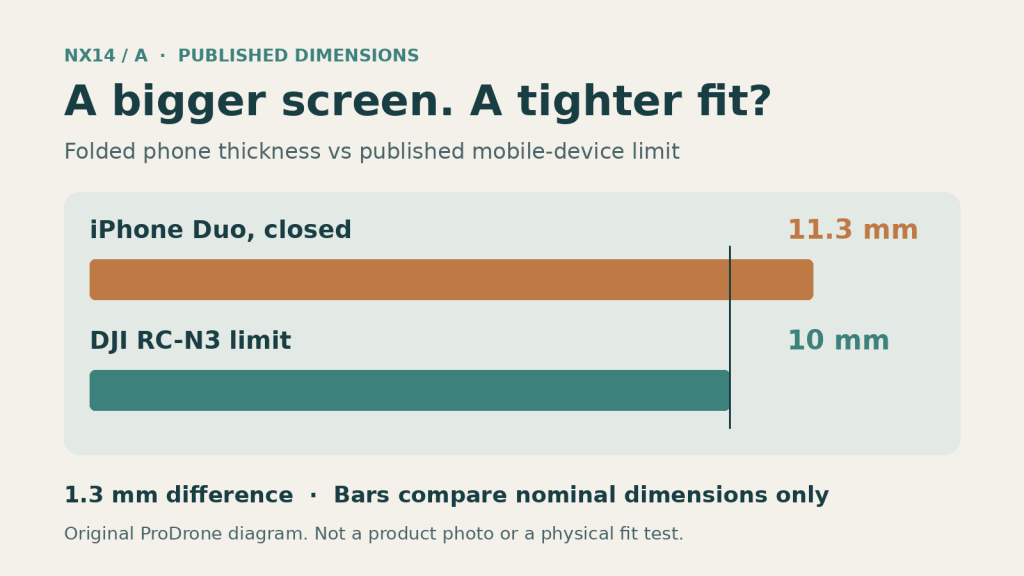
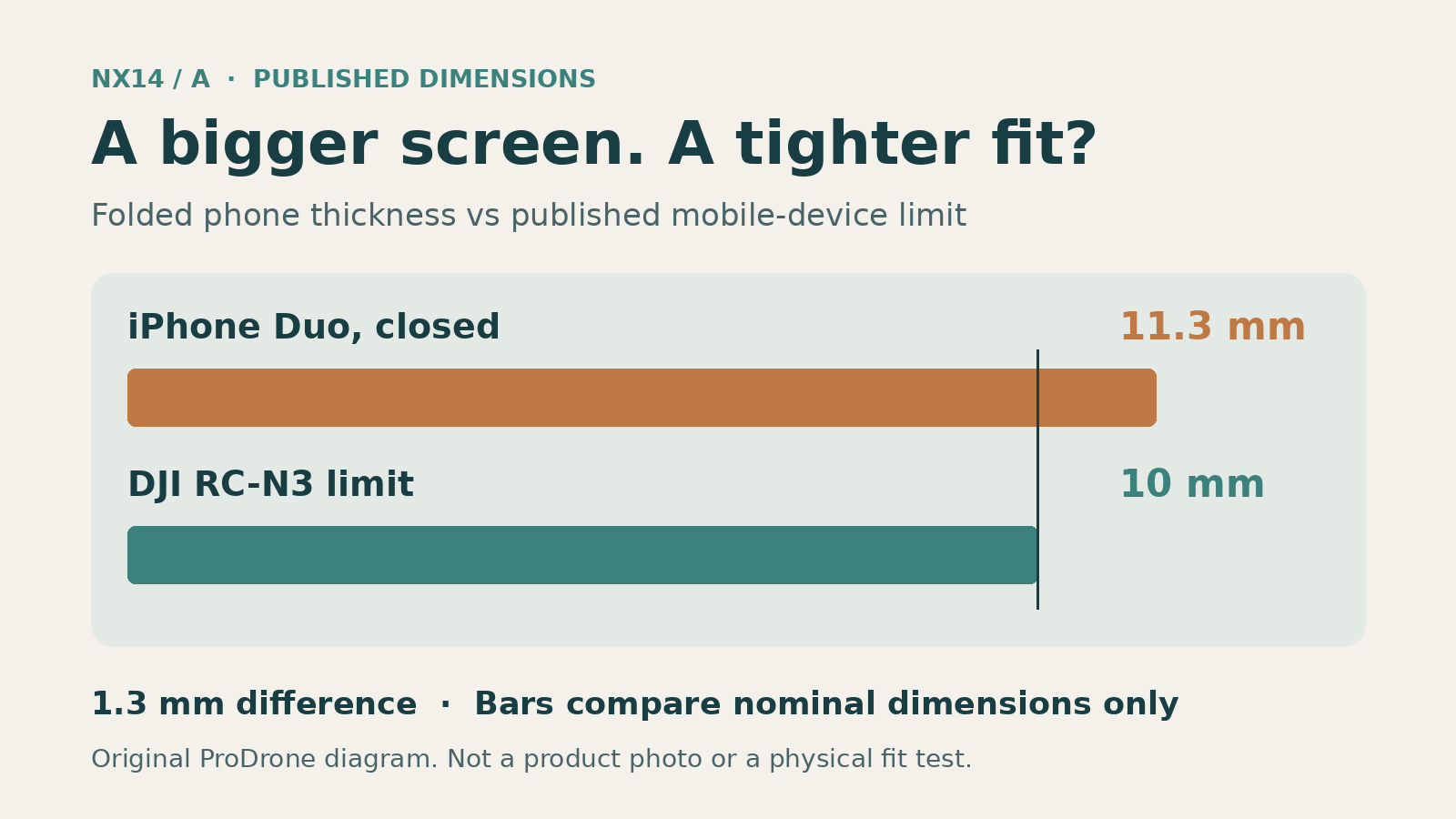
DJI’s official specification for the RC-N3 controller gives a maximum supported mobile-device size of 180 × 86 × 10 mm (length × width × height).
The closed phone looks compact enough on its first two measurements. But its 11.3 mm folded thickness exceeds DJI’s published 10 mm holder limit by 1.3 mm. Opening the device removes that thickness concern but introduces a different geometric question: the open body’s shorter side is 117.8 mm, well over the holder’s stated 86 mm second dimension. Orientation and exactly where the holder grips the device matter.
Neither comparison is a hands-on fit test. The manufacturer specifications establish a reason to be cautious—not a definitive statement about what somebody might force into a clamp, attach using another mount or operate with a third-party accessory.
Why a 1.3 mm mismatch is not a trivial rounding error
Phone holders have a purpose beyond simply keeping a device from falling on the floor. They need to hold it steadily while the pilot moves the control sticks, tilts the remote and shifts position. A folding phone introduces a hinge and a shape that conventional straight-backed handsets do not have.
A tight fit achieved by forcing the holder open is not equivalent to a supported fit. And a case, screen protector or charging adapter may add dimensions the original device specification does not include.
There is also a practical balance question. A 254 g phone is a different load from some conventional handsets. DJI’s size figure alone says nothing about how a specific aftermarket mounting solution would affect comfort or centre of gravity. That should be checked separately.
App compatibility is a different decision
DJI says the RC-N3 uses a phone running the DJI Fly app to display the live camera feed, and it supplies USB-C and Lightning remote-control cables depending on the connection needed.
But a cable fitting the phone is not proof that the app and the device work correctly together. DJI maintains a separate official phone compatibility article, which cautions that devices not tested by DJI cannot be assumed to offer stable performance. The page we checked does not establish a verified iPhone Duo test result.
iPhone Duo also has a folding display. Even if DJI Fly installs and launches, that alone cannot answer whether the user interface, display orientation, live video, connection reliability and sustained operation have been tested in both the folded and unfolded modes.
A stable cable connection would settle one part of the setup. It would leave the folding-screen behaviour and the grip untested.
A more useful checklist than “does it work?”
Before spending money on a replacement holder—or deciding that the new phone will become your primary drone screen—confirm the following with current manufacturer guidance or a documented real-device trial:
- Physical grip: Can the mount secure the device without pressure on the hinge, buttons or screen? Check the phone’s measurements including its case.
- Cable routing: Does the required cable connect naturally, without a sharp bend at the connector?
- Software: Does the current DJI Fly version launch and maintain connection on that particular iPhone Duo/iOS combination?
- Flight-readiness: Are live video, critical status indications and control operation reliable? A menu opening successfully isn’t a substitute for this verification.
- Mounting method: If a third-party tablet-style holder is used, is the complete arrangement stable and appropriate for the controller?
This is deliberately not a recommendation to perform unverified flight experiments. A pilot should follow the aircraft/controller manufacturer’s guidance and avoid relying on an untested setup for an actual flight.
So is it compatible?
We cannot honestly call the iPhone Duo and RC-N3 combination confirmed compatible on the published evidence alone. The manufacturer dimensions contain clear fit concerns in both configurations, and the separately required DJI Fly/device test has not been verified here. A different holder could change the physical part of the answer; it would not, by itself, certify the app.
If you’re buying the phone mainly as a drone display, check the complete mounted setup before making that purchase. An aftermarket holder may solve a mechanical problem; evidence of DJI Fly stability is still a separate requirement.
Visual disclosure: original ProDrone dimension diagram, not a product photograph or a physical fit test. Text and diagram prepared with AI assistance.
Primary references (specifications checked 20 October; DJI main-store link rechecked 21 October 2026)
- Apple, iPhone Duo – Technical Specifications (dimensions, weight): https://www.apple.com/iphone-duo/specs/
- Apple, Open up to new possibilities with iPhone Duo, 15 October 2026 (product availability context): https://www.apple.com/newsroom/2026/10/open-up-to-new-possibilities-with-iphone-duo/
- DJI, RC-N3 Remote Controller (180 × 86 × 10 mm maximum size, cables): https://store.dji.com/product/dji-rc-n3-remote-controller
- DJI, DJI Fly or DJI GO 4 Phone Compatibility List (device testing caveat): https://repair.dji.com/help/content?customId=en-us03400006560&lang=en&paperDocType=paper&re=US&spaceId=34

