A drone dock is easy to picture when the aircraft is a quadcopter: it rises vertically from a landing pad and returns to roughly the same spot. A fixed-wing aircraft creates a different problem. It normally needs room to gain flying speed and a way to slow down and land. So what does a company mean when it promises a fixed-wing drone that can launch from a dock without a runway?
Skydio introduced the F10 Lightrunner and MegaDock on September 24, 2026. The company uses the term Robotic Takeoff and Landing (RTOL) for the system that launches and recovers the fixed-wing aircraft. The phrase is useful for buyers because it describes a physical handling method, not a new permission to fly automatically wherever a dock can be installed.
RTOL describes a launch-and-recovery mechanism
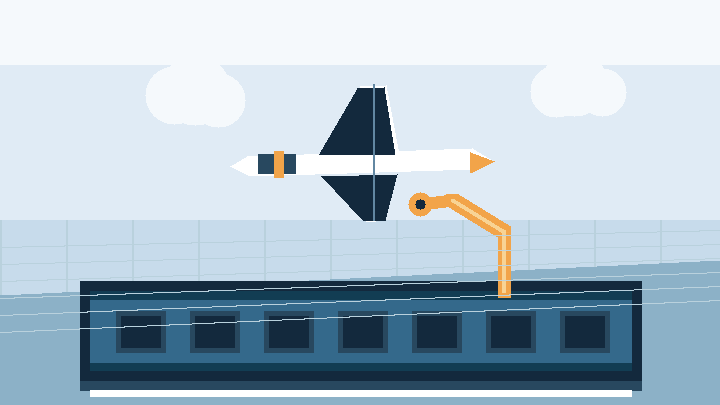
According to Skydio’s launch announcement, MegaDock uses a robotic gripper with suction-based handling to launch and catch F10. The aircraft does not need to roll along a runway for these stages. The manufacturer says MegaDock can hold up to five F10 aircraft and charge them between missions.
This is a different engineering answer from a multirotor dock. The fixed-wing aircraft must transition between being held by the robot and flying under its own lift, then be captured again on return. The exact forces, tolerances and reliability of that transition cannot be established from a marketing animation or a product description alone. No independent performance test was conducted for this article.
A buyer should therefore separate three questions: Can the robot handle the aircraft? Can the aircraft fly the intended route? And can the entire installation operate safely and legally at the proposed site? A product announcement answers only part of that checklist.
Why a five-aircraft dock does not mean five simultaneous missions are automatically permitted
The manufacturer’s MegaDock FAQ says the station houses up to five fixed-wing aircraft. That is a storage and system-capacity statement. It is not a blanket authorization for one remote pilot to operate five aircraft simultaneously, nor proof that five missions will always be ready at the same time.
An operator still needs to examine charge state, maintenance, communications, weather and the flight approvals applicable to the mission. Skydio’s F10 FAQ explicitly discusses beyond-visual-line-of-sight (BVLOS) authorizations for US operators. The FAA also maintains a Part 107 waiver process. Requirements vary with the operating organization, aircraft and proposed mission.
The useful procurement question is not simply “How many drones fit inside?” It is “Under our actual operating approvals and staffing model, how many can we dispatch, monitor and recover safely?”
A robotic dock is infrastructure, not just an accessory
Skydio’s published MegaDock FAQ describes an installation requiring power, wired network connectivity and physical space. Its specifications and deployment conditions matter as much as the aircraft headline.
Before budgeting for any docked operation, a prospective buyer should map the site: who controls the land, where the launch-and-capture area sits, what happens if power or network service fails, how maintenance staff gain access, and which flight restrictions apply. A rural utility inspection base and a dense urban emergency-response location may face very different constraints.
The company also publishes weather limits for launching and recovering the F10. Those are manufacturer specifications, not a guarantee that a mission is suitable in every rain or wind condition. The safest reading is to treat a published limit as one boundary among several, not as a target to approach routinely.
RTOL versus automated battery swapping: two different problems
The term RTOL is easy to confuse with other recent dock technologies. DJI’s Dock 4 announcement, for example, emphasizes automated battery exchange for a multirotor workflow. Skydio’s MegaDock description emphasizes robotic handling of a fixed-wing aircraft during launch and recovery. Both are forms of ground automation, but they do not solve the same bottleneck.
A battery swap can reduce one kind of turnaround delay. Robotic fixed-wing recovery addresses the need to get an aircraft into and out of flight without a conventional runway. Neither mechanism removes the need for mission planning, inspections, airspace permissions or a credible recovery plan.
For an inspection organization, this distinction matters more than the general label “autonomous dock.” Start by defining the mission and the constraint: Is the problem flight endurance, travel distance, launch space, turnaround time, or operator workload? The appropriate technology depends on the answer.
Five checks before treating RTOL as a procurement requirement
First, confirm the product’s status. Skydio’s September announcement describes F10 deployments beginning in 2027. A launch announcement is not evidence of a currently delivered, independently verified fleet at the buyer’s site.
Second, check the actual site footprint and utilities. Review the manufacturer’s latest MegaDock site-readiness material rather than relying on a rendering.
Third, ask for the complete operating concept. Who monitors missions, handles lost communications, approves flights, and performs maintenance? An unattended launch location is not an unattended safety responsibility.
Fourth, request evidence appropriate to the proposed mission. A manufacturer demonstration, a third-party test and an operational acceptance trial answer different questions. Do not treat published maximum figures as guaranteed results.
Fifth, compare alternatives on the same task. A multirotor, a conventional fixed-wing system, a remotely operated camera or an existing aerial-imagery service may each be a better fit depending on the site and frequency of inspection.
RTOL is a useful new term precisely because it points to a concrete mechanical challenge. It should help buyers ask better questions, not replace those questions with a futuristic label.
Sources
- Skydio, “Skydio Extends Its Family of Flying Robots Platform With F10 Lightrunner and MegaDock” (September 24, 2026): https://www.skydio.com/blog/ascend-2026-f10-lightrunner-megadock-commands
- Skydio, “Frequently Asked Questions About MegaDock” (manufacturer specifications and site requirements): https://www.skydio.com/f10/megadock-faqs
- Skydio, “Frequently Asked Questions About F10 Lightrunner” (operations and US approvals): https://www.skydio.com/f10/faqs
- US Federal Aviation Administration, “Part 107 Waivers” (regulatory process, not approval of any particular system): https://www.faa.gov/uas/commercial_operators/part_107_waivers
Sources accessed November 1, 2026. Manufacturer statements are attributed to the manufacturer; they are not independently verified flight or dock-performance results. The discussion concerns civilian inspection and emergency-response applications, not military use.
Editorial and commercial disclosure: ProDrone operates a drone-products business. This independent editorial explainer is not sponsored by Skydio or DJI, is not a product test, and does not imply stock availability, a sales relationship or a purchase recommendation.


Leave a Reply